Pixel Art for Games Lesson 5 of 6
Making a game-ready sprite
Silhouette first, readability at actual size, consistent scale.
A game sprite has a job the moment it appears on screen: the player must instantly recognize what it is, often while it is small and moving. That means the silhouette — the solid outer shape — has to be readable on its own.
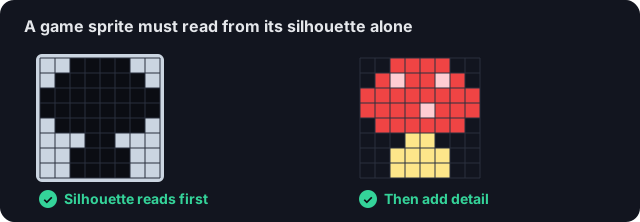
If the solid silhouette (left) reads as your subject, interior detail (right) only has to enrich it.
- Draw the silhouette as a solid shape and check it reads as your subject with zero interior detail
- Add the biggest interior shapes (the main color regions) next
- Only then add small details — and only the ones that survive at actual game size
- Zoom out to 100% game scale frequently; if a detail turns to mush, cut it
Your turn
Fill in the mushroom silhouette as one solid shape.
Paint every cell of the shape in one color — no interior detail yet. It should read as a mushroom from the solid shape alone.
Match 85% to pass · now at 0%
Tip Keep a consistent pixel scale across a set. If your character is 32px tall, do not draw a 200px-tall tree at the same detail level — it will read as belonging to a different game. Cohesion is one scale, one palette, one light.
Quick check
Why start a sprite from its silhouette?